Model importance in ensembles
Ensembles review
- Combining many models usually beats any single one.
But which member models actually make the ensemble better?
- We turn to the idea of Shapley values from game theory for inspiration.
Standard scoring answers a different question
- Standard metrics score each model on its own.
- That measures standalone skill – not a model’s contribution to the ensemble.
- A strong standalone model is not guaranteed to help the ensemble; a model can even hurt it (a negative contribution).(Kim et al. 2026)
Note
Model importance is to ensemble members what variable importance is to features in a random forest – but measured at the level of whole models.
The core idea
A model’s importance = how much the ensemble’s accuracy changes when that model is added or removed.
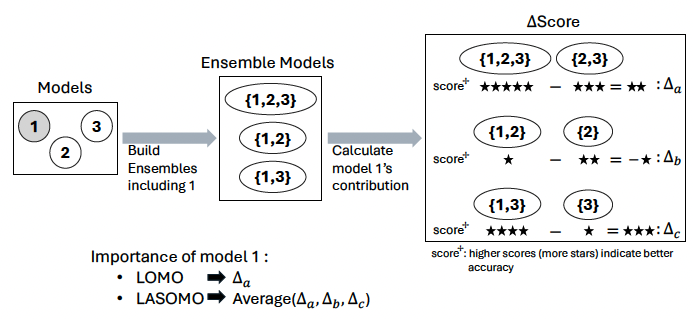
Conceptual illustration (three models). Stars = accuracy by a positively-oriented score, e.g. -WIS.
Leave-One-Model-Out (LOMO)
Compare the full ensemble to the ensemble with one model removed.
- A = set of n models; F^{A} = full ensemble forecast.
- F^{A^{-i}} = ensemble of every model except i.
- Importance of i = accuracy of F^{A} - accuracy of F^{A^{-i}} (positively oriented, so >0 means model i helps).
Example with n=3: to score model 1, build the ensemble of \{2,3\} and compare it to \{1,2,3\}.
Leave-All-Subsets-of-Models-Out (LASOMO)
- LOMO uses a single comparison (full vs full-minus-i).
- LASOMO averages model i’s contribution over all subsets that exclude it – the full Shapley-value idea (more complete, but more expensive).
Example with n=3, scoring model 1: take every subset without model 1 — \{2\}, \{3\}, \{2,3\} — and for each compare the ensemble with model 1 added vs. without it (F^{S \cup \{1\}} vs F^{S}), then aggregate.
The modelimportance R package
model_importance()returns a per-task importance score for each ensemble member.- LOMO or LASOMO; point and probabilistic forecasts; configurable handling of missing forecasts.
- Built on the hubverse (
hubUtils,hubEnsembles,hubEvals), so it drops straight into existing hubs. print(),summary(),aggregate().
Example: Flu MetroCast Hub 2025/26
- Hub run by epiENGAGE Insight Net center
- National Syndromic Surveillance Program (NSSP) data
- Target: weekly % of ED visits due to flu
- Locations: 64 states and Health Service Areas (HSA)
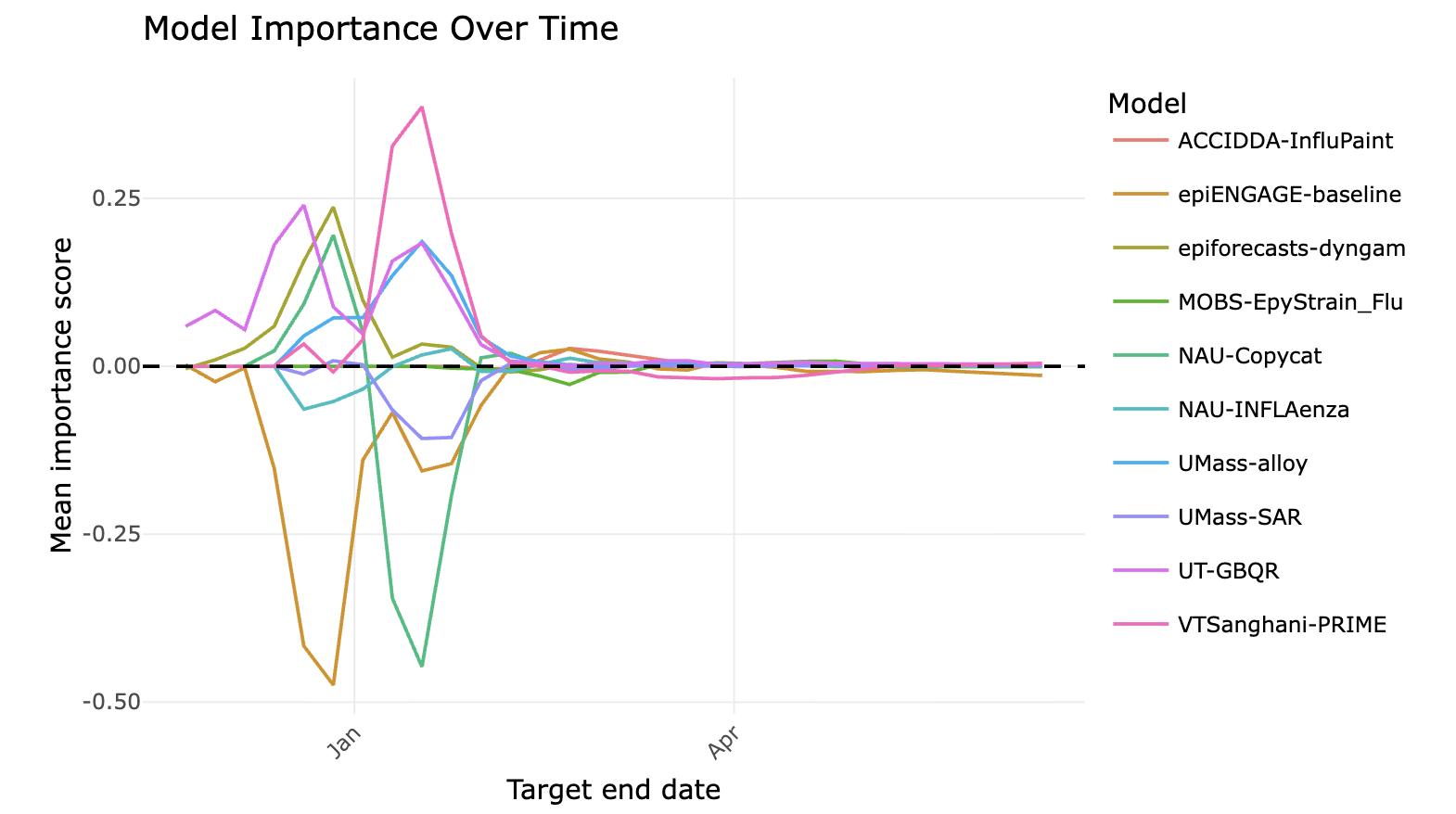
- Models: 10 from various academic groups
- Missing forecasts receive a
0importance for those tasks
Example: LOMO results
Takeaways
- An ensemble is only as good as the mix of its members – not each member’s solo skill.
- LOMO: quick and intuitive (full vs leave-one-out). LASOMO: more like Shapley values, but computationally costlier.
modelimportancemakes this a one-function, hubverse-native analysis.- Full method and a large-scale application: Kim et al. (2026).
References
Model importance