Modelling complex reporting processes
The model we have so far
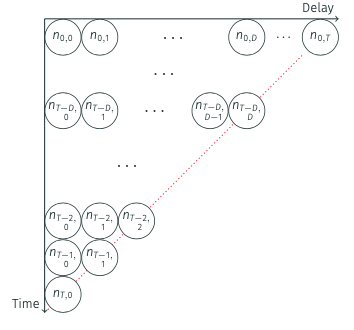
In the joint nowcasting session we modelled each cell of the reporting triangle as
\[ n_{t,d} \mid \lambda_{t}, p_{t,d} \sim \text{Poisson}\left(\lambda_{t} \times p_{t,d}\right) \]
- \(\lambda_{t}\): expected onsets on day \(t\) (a daily random walk)
- \(p_{t,d}\): probability of an onset on day \(t\) being reported with delay \(d\)
- a single delay distribution, the same on every day
Ideal for learning, and fine when the reporting process is simple.
Real reporting is messier
A single, fixed delay cannot capture:
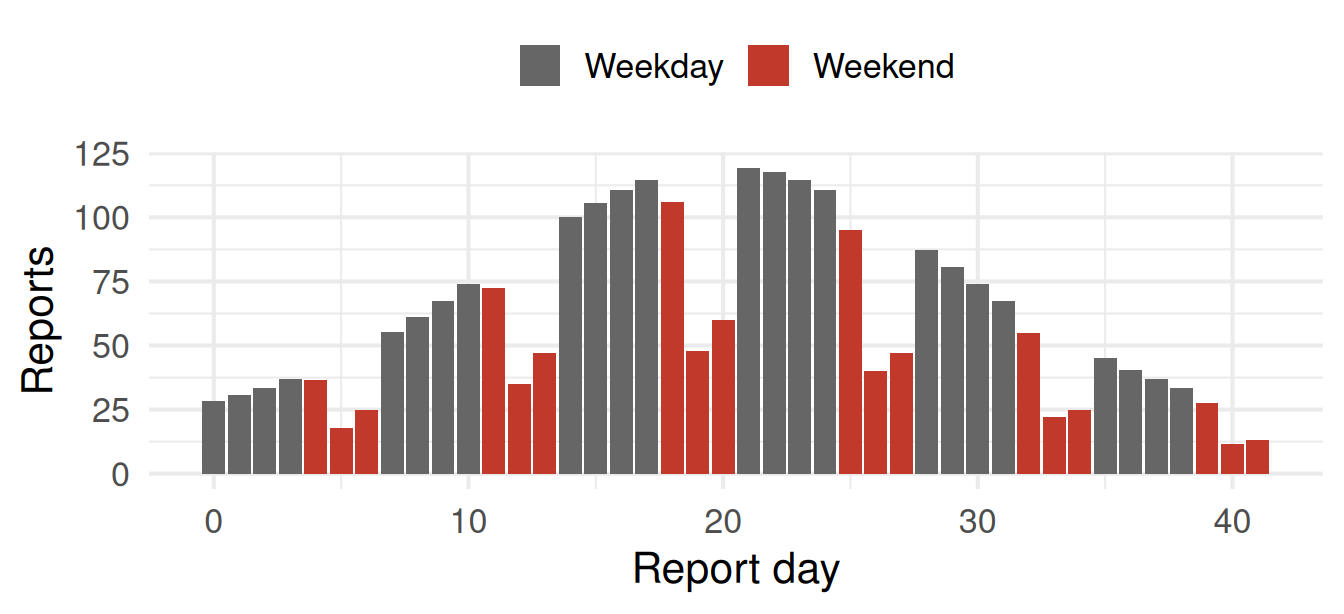
- Day-of-week effects (fewer onsets or reports at weekends, or delays that differ by weekday)
- Time-varying delays (delays drift as a system gains or loses capacity)
- Weekly / batched reporting (data released weekly, not daily)
- Strata (delays differ by age, region, …)
- Missing reference dates
Day-of-week effects
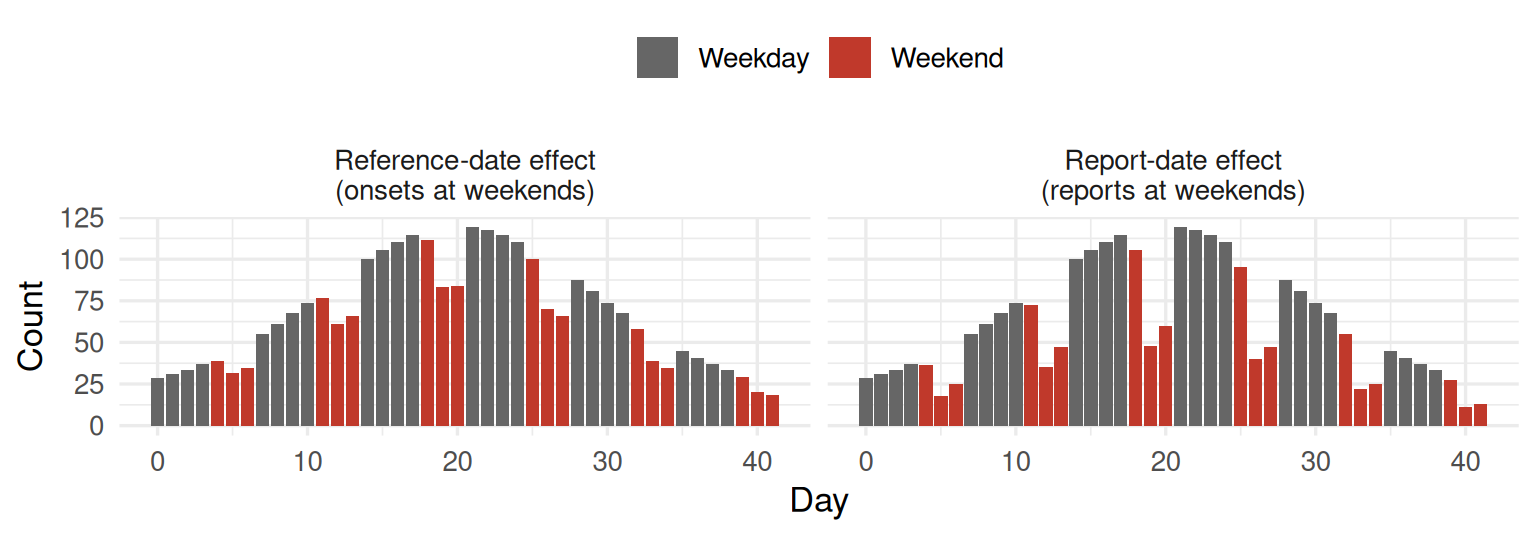
A weekly pattern can enter in three distinct places:
- Reference date, on the counts: events truly happen at different rates by day of week → goes in the expectation module
- Reference date, on the delay: the delay distribution itself differs by the onset day of week → goes in the reference module
- Report date: the system processes reports at different rates by day of week → goes in the report module
Time-varying delay
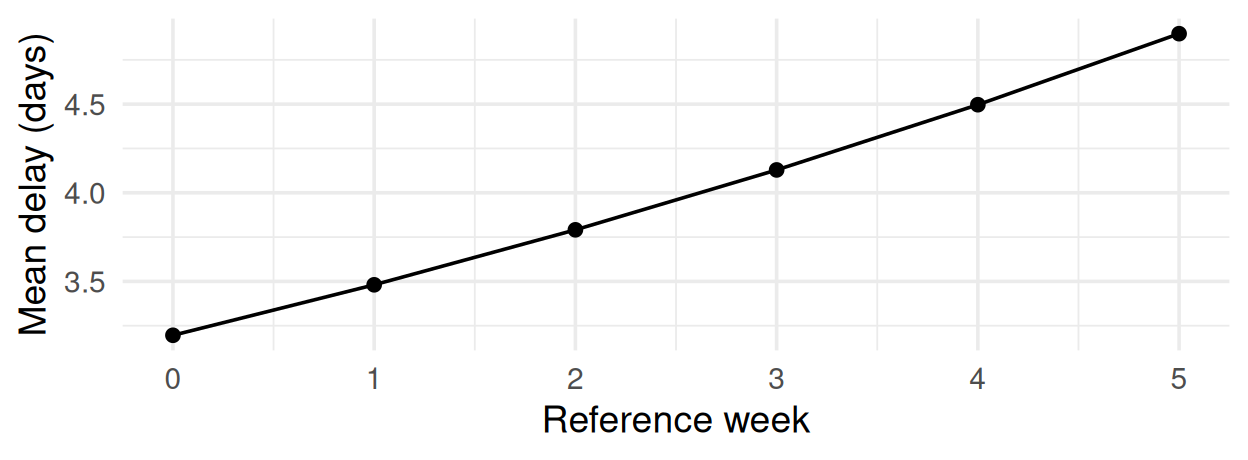
Delays may lengthen under strain and shorten with spare capacity.